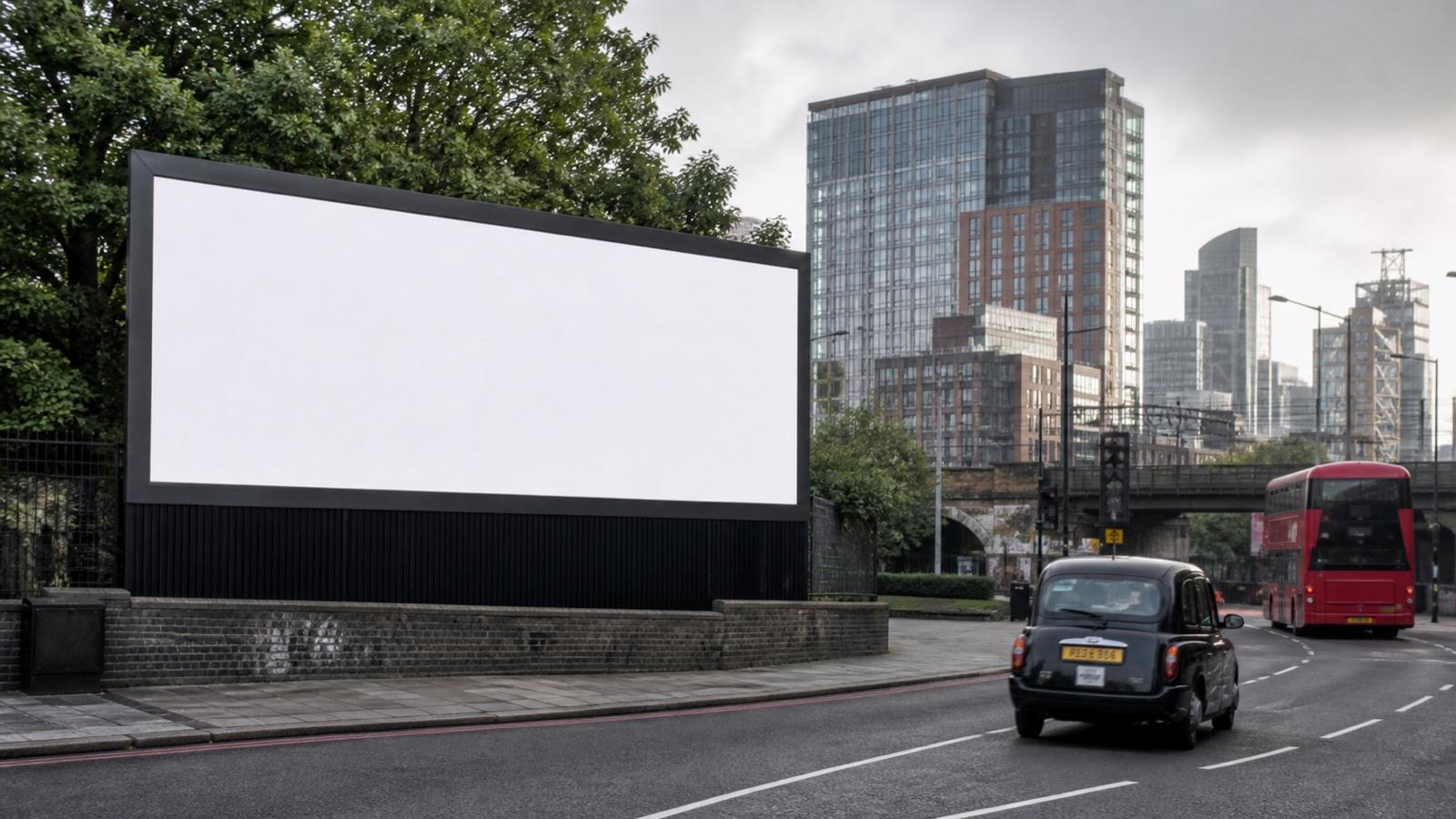
Leeds Wellington Street 48-Sheet
Leeds
£1,280
per 2-week cycle
per 2-week cycle
A sample of what owners are listing right now.
Marketplace ranges, not a rate card — every space is priced by its owner.
| What you're buying | Typical range | What moves it |
|---|---|---|
| 6-sheet, street level | £150 – £550per 2-week cycle | Footfall and what the panel stands outside. A supermarket entrance costs several times a residential parade. |
| 48-sheet (12 × 3 m) | £450 – £3,000per week | Traffic volume and the approach angle. A three-lane arterial into a city centre sits at the top; an unlit B-road site at the bottom. |
| 96-sheet (12 × 6 m) | £1,200 – £6,000per week | Twice the face of a 48-sheet, rarely twice the price — how few sites exist on that road matters more than the area. |
| Wallscape or gable end | £3,000 – £25,000per 4-week cycle | One-off sites with no comparable. Hand-painting adds a crew, scaffold and four to six days on top of the space. |
| Illumination | +10% – 25%on the panel rate | Buys the evening and winter commute. Worth most between October and February and close to nothing in June. |
Ranges are what buyers typically pay across the marketplace, not a rate card. Every space is priced by the company that owns it, and the price on a listing is what a buyer pays.
What buyers check before they book this format.
Where buyers of billboards put the rest of the budget.
A 48-sheet on a normal urban road runs from a few hundred pounds a week to around £3,000, and a gateway site on a major arterial into a city can be several times that. Six-sheets at street level start lower and are usually sold in two-week cycles; one-off wallscapes are priced on their own. The price on a listing is set by the site owner and is what a buyer pays.
Two weeks is the usual minimum on paper sites and four on hand-painted or banner ones, because posting costs the owner the same whatever the run length. Four weeks is the most common booking for a launch. Longer runs are discounted, but the curve is shallow — expect a few percent per extra cycle, not a halving.
Usually not. Most listings include posting and removal by the site owner's crew, and many owners will print for you or point you at the printer they use. If you print separately, supply the sheets to the owner's specification and delivery address, and allow a spare set so a re-post takes days rather than a fortnight.
Build to the exact proportions of the face and supply at 1:10 with fonts outlined — a 48-sheet artwork is 1200 × 300 mm at that scale. Keep type well inside the edges and work in CMYK. Check the design at thumbnail size: if it does not read at four centimetres it will not read at forty metres.
Billboards are the fixed, large-format panels you pass on a road or a high street: a 6-sheet at pavement level beside a bus stop, a 48-sheet on the approach to a junction, a 96-sheet across the end of a retail park, or a painted gable end that takes a crew most of a week to finish. What they share is a fixed position — the audience moves, the panel does not.
Buying one comes down to picking the site, the weeks and the size, then getting a printed sheet to the owner's crew in time for the posting cycle. Everything below covers how panels are sized, priced and measured, what the print and the deadlines actually demand, and the questions worth asking before you commit a fortnight's budget to one face.
Sizes are still quoted in sheets, a hangover from the days when a poster was pasted up from separate printed sheets. A 6-sheet is 1.8 metres tall by 1.2 wide, portrait, usually glazed into street furniture at eye level and read by people on foot. A 48-sheet is 12 metres by 3, landscape, mounted at roughly four metres and angled at traffic — the panel most people picture. A 96-sheet doubles that to 12 by 6. In between sit 16-sheets at 3 by 2 metres and 64-sheets; above them sit wallscapes and gable ends, which are one-off sites measured individually rather than in sheets.
The other split is how the face is made. Paper posters are wet-pasted onto the panel by a crew and come off at the end of the cycle. PVC and mesh banners are tensioned into a frame, last longer and suit sites that are hard to reach. Hand-painted walls are exactly that — a crew on scaffold for four to six days, repainted back to base at the end of the run. Illumination is the last variable: front-lit sites carry floodlights on a timer, backlit panels are lit from inside, and an unlit site effectively stops working between October and March, when the commute happens in the dark.
Owners quote an impressions figure built from traffic or footfall past the site, discounted for visibility — angle, distance, dwell and illumination. It is a modelled estimate rather than a count, so compare like with like: the same time window, the same single face, and the same treatment of the hours after dark.
Yes, but you pay for it. A change means a new print and a new posting visit, which is why most billboard campaigns run one execution per cycle and rotate creative between cycles. If you need to change a message at short notice, book digital screens alongside the paper.
Most owners run a weekly condition check and will re-post a torn or vandalised sheet, often free of charge in the first week of a run. Confirm the policy before booking, and keep spare sheets on site so the crew can act on the next visit rather than the next cycle.
Billboards are sold by the panel by the week, on a cycle that usually starts on a Monday. Two weeks is the common minimum, because posting a sheet costs the owner the same whether it stays up for seven days or twenty-eight; four weeks is the standard run for a launch. The discount curve is real but shallow — two weeks is rarely twice the one-week price and four weeks is rarely four times it, so ask for the four-week figure even if you are planning two.
The price of a face is set by the owner and reflects the audience passing it, the competition on the same stretch of road, and how often the site sells out. A listing is either Book now at a fixed price, Make offer, Request quote, or a closed bid where sealed bids are taken and the space goes to the highest at close. Posting and removal sit inside the listed price on most sites; printing the sheet often does not, though the print bill on a 48-sheet is a small fraction of the space and rarely changes the decision.
Outdoor audience figures are not headcounts. They start from traffic and pedestrian counts past the site, then discount them for whether the panel could actually be seen: the angle it sits at, the distance it is legible from, how long a driver holds it in view, whether other panels compete on the same approach, and whether it is lit after dark. What comes out is an impressions figure, usually quoted daily or weekly.
That means two sites quoting similar numbers are not necessarily comparable. Check the window the figure covers — an illuminated site quoting 24 hours will beat an unlit site quoting daylight only, for reasons that have nothing to do with the panel. Check whether the number is for the face you are buying or for a structure carrying two or three faces pointing different ways. And treat a weekly reach figure as a modelled estimate of distinct people, not a promise.
Artwork goes to the owner as a print-ready PDF built to the exact face proportions, normally supplied at 1:10 scale with fonts outlined and images in CMYK. The design has to survive being read at speed from fifty metres: a handful of words, one mark, and enough contrast to work in flat winter light. Bleed matters less than the safe area — trims and overlaps at the panel edge eat a few centimetres on every side.
Five working days before the posting date is the normal deadline for a paper 48-sheet, and it is a deadline because the crew's week is planned around it. Banners want longer, hand-painted walls three weeks, and multi-site campaigns want every sheet supplied in one delivery. Order a spare set: a torn or badly pasted poster is fixed by re-posting, and a re-post is quick only if the paper is already on site.
The format buys fame in a specific place. Nobody scrolls past a 48-sheet, nobody blocks it, and a site on the road into a town means everyone who drives that road sees the same thing repeatedly for a fortnight. That makes it strong for launches, for local dominance, for recruitment inside a catchment, and for anything where being seen many times by the same people matters more than reaching different ones.
It is weak wherever precision is the point. There is no click, no targeting beyond geography and time of day, and the measurement is modelled rather than counted. Copy is fixed for the cycle, so changing a message mid-run means paying to print and post again. And the site is exposed: scaffolding, a parked lorry, a tree in leaf or a wet fortnight all take value out of a panel, and none of them appear on the rate.
Ask for a photograph taken from the direction of travel rather than a flattering three-quarter shot. It tells you the read time, the approach and what else competes on the same stretch. Then check the practical terms: illumination hours, the minimum booking, whether posting and removal are inside the price, whether the panel carries category exclusions — alcohol, gambling and HFSS restrictions are common near schools — and how obstructions are handled if one appears mid-run.
Finally, check the cycle and the paperwork. Confirm the in-charge date rather than assuming your fortnight starts when you want it to, confirm the artwork deadline in working days, and confirm what happens if the sheet is damaged in week one. The proof photograph is the receipt: dated and GPS-tagged, with payment held until you approve it.